A century of the Montessori method.
How a physician's experiment in one Roman classroom grew into a method practiced in thousands of schools worldwide.
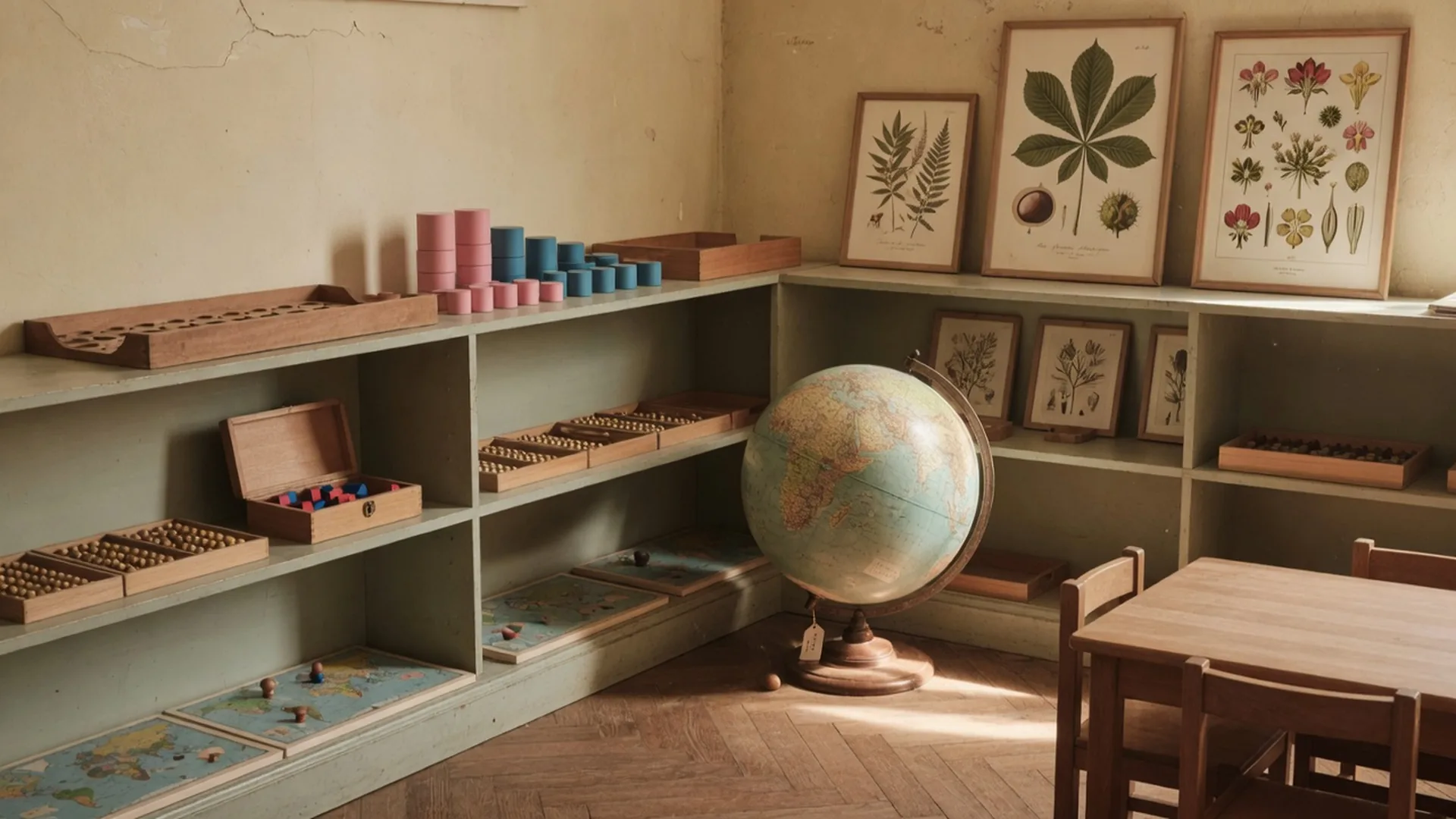
Most parents first meet Montessori as a word on a preschool sign, and the word is doing a lot of work. Behind it stands more than a century of practice: a physician's experiment in a poor quarter of Rome, a movement that crossed the Atlantic twice, and a classroom method that has outlasted every education fashion since. The history is worth a few minutes of your attention for one practical reason. The name is free for anyone to use. The substance behind it is what you are actually shopping for.
The doctor before the educator
Maria Montessori was born in 1870 in Chiaravalle, Italy. She talked her way into the University of Rome's medical program over the objections of nearly everyone involved, and in 1896 she became one of the first women in Italy to earn a medical degree. She was a physician before she was an educator, and that ordering shaped everything that followed.
Her early clinical work brought her to children the institutions of her day had written off. Montessori studied the earlier work of the French physicians Jean Itard and Edouard Seguin, built teaching materials with her own hands, and watched what the children did with them. They learned. Some passed the same public examinations as their typically developing peers. Her conclusion was blunt: the failure had been the teaching, not the children. The obvious next question was what careful observation could do for every child.
One room in San Lorenzo, 1907
On January 6, 1907, Montessori opened the first Casa dei Bambini, the Children's House, in San Lorenzo, a struggling district of Rome. She took charge of roughly fifty children of working parents, most between 3 and 6 years old. She did not arrive with a finished method. She arrived with a scientist's habit: observe first, intervene second, and keep only what works.
What she observed surprised her. Given real tools scaled to their bodies, the children preferred purposeful work to toys. They repeated an activity dozens of times, not for a reward but for mastery. They concentrated for long stretches once adults stopped interrupting them. They began caring for the room without being asked. Order, independence, and deep attention were not qualities she trained into the children. They surfaced on their own when the environment allowed them to.
Nearly everything parents recognize in a Montessori classroom today (the low open shelves, the child-sized furniture, the self-correcting materials, the long uninterrupted work period) earned its place in those first years by a single test: did it hold the child's attention and move the child forward. Whatever failed that test was removed, however good the theory behind it sounded.
A method travels the world
The results in San Lorenzo were difficult to ignore, and visitors came from across Europe to see them. Montessori published her first account of the method in 1909 and gave her first international training course the same year. Within a decade there were Montessori classrooms across Europe and well beyond it. She spent the rest of her life training teachers on several continents, including nearly a decade in India through the 1940s, where she trained thousands of them. She was nominated for the Nobel Peace Prize three times before her death in the Netherlands in 1952.
America falls for Montessori, twice
The United States adopted the method early and enthusiastically. The first American Montessori school opened in 1911, national magazines ran admiring coverage, and at the 1915 world's fair in San Francisco a working classroom sat behind glass so fairgoers could watch the children at work. Then the enthusiasm collapsed almost as quickly as it had risen. An influential 1914 critique from a prominent education professor, a world war, and shifting fashions in American schooling pushed Montessori to the margins for four decades.
The second wave held. In 1958 Nancy McCormick Rambusch founded the Whitby School in Connecticut, and in 1960 she founded the American Montessori Society to root the method in American culture. This time it grew: independent schools, university-affiliated training programs, and eventually hundreds of public Montessori programs across the country.
AMI and AMS, in plain language
Parents researching schools quickly run into two acronyms. The Association Montessori Internationale (AMI) was founded in 1929 by Maria Montessori and her son Mario to protect the method's standards as it spread. The American Montessori Society (AMS) was founded in 1960, during the American revival, to adapt the method to an American context. Both run rigorous teacher training, both hold schools to published standards, and both are respected worldwide. The differences are real but modest, more a matter of emphasis than of substance. What tells you far more than the letters after a school's name is what happens in its classrooms: trained guides, full mixed-age cycles, real materials, and protected work periods.
The name is free. The substance is not.
Here is the fact every touring parent should know: Montessori is not a trademark. A 1967 United States ruling held that the word is generic, so any school may put it on the sign regardless of what happens inside. Partly because the name is free, the method's reach today is enormous, with thousands of schools across the world. Quality varies just as widely, from faithful classrooms to conventional daycare with wooden toys and a borrowed word.
The only reliable filter is substance, and we keep two plain-language guides for exactly that purpose: what the method is and why it works, and what it looks like in practice, hour by hour. When you are ready to walk through a door, take our touring checklist with you. Read all three before you tour any school, ours included.
The short version
- 1870 Maria Montessori is born in Chiaravalle, Italy.
- 1896 She earns a medical degree from the University of Rome, one of the first women in Italy to do so.
- 1907 The first Casa dei Bambini opens in the San Lorenzo district of Rome on January 6.
- 1909 She publishes her first account of the method and gives her first training course.
- 1911 The first American Montessori school opens, and the first US wave begins.
- 1915 A working glass-walled classroom draws crowds at the San Francisco world's fair.
- 1929 Montessori and her son Mario found the Association Montessori Internationale (AMI).
- 1939 She travels to India and trains thousands of teachers over the following years.
- 1949 The first of three Nobel Peace Prize nominations.
- 1952 Maria Montessori dies in the Netherlands at 81.
- 1958 The Whitby School opens in Connecticut, and the American revival begins.
- 1960 The American Montessori Society (AMS) is founded.
- 1967 A US ruling confirms that Montessori is a generic term, not a trademark.
- 1997 The Montessori School of Fairfax opens in Chantilly, VA.
The lineage in Chantilly
The Montessori School of Fairfax opened on Lees Corner Road in 1997, well into Montessori's second American century. We did not invent anything described on this page, and that is precisely the point. For 29 years we have practiced the method as its history defines it: trained guides, full three-year cycles, real materials, and the long protected work period Montessori first defended in San Lorenzo. A century of evidence is a strong argument. Watching it work in a classroom near your house is a better one. See what 29 years of it builds here.