Why Montessori works.
A century of practice, a growing body of research, & results you can watch happen in a single classroom morning.
Independence
It starts with "I can do it myself."
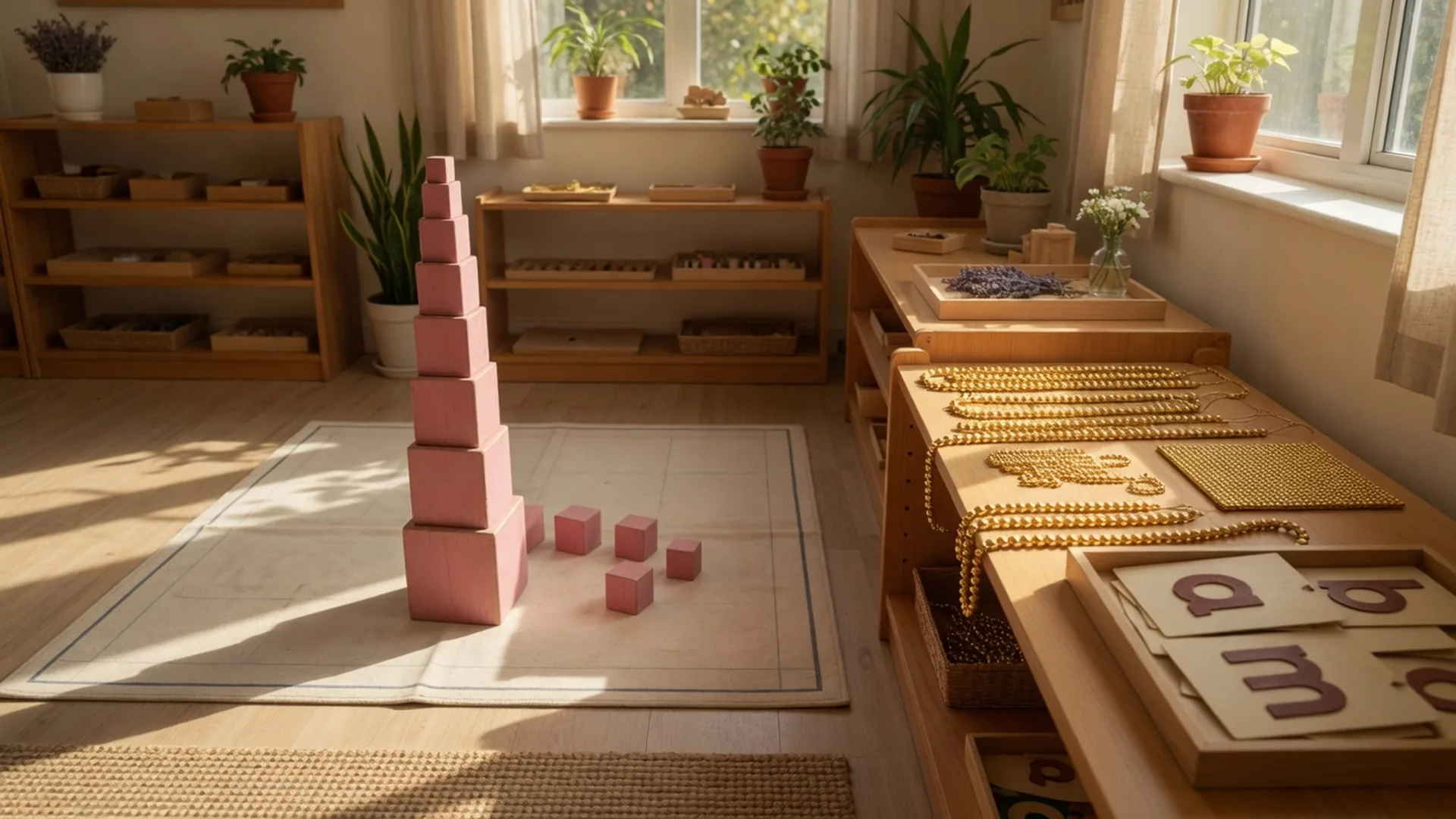
Every Montessori material, from the pink tower to the moveable alphabet, is designed so a child can choose it, work with it, check the result, and put it away without an adult in the loop. That full loop, choice to completion, is the engine of the entire method.
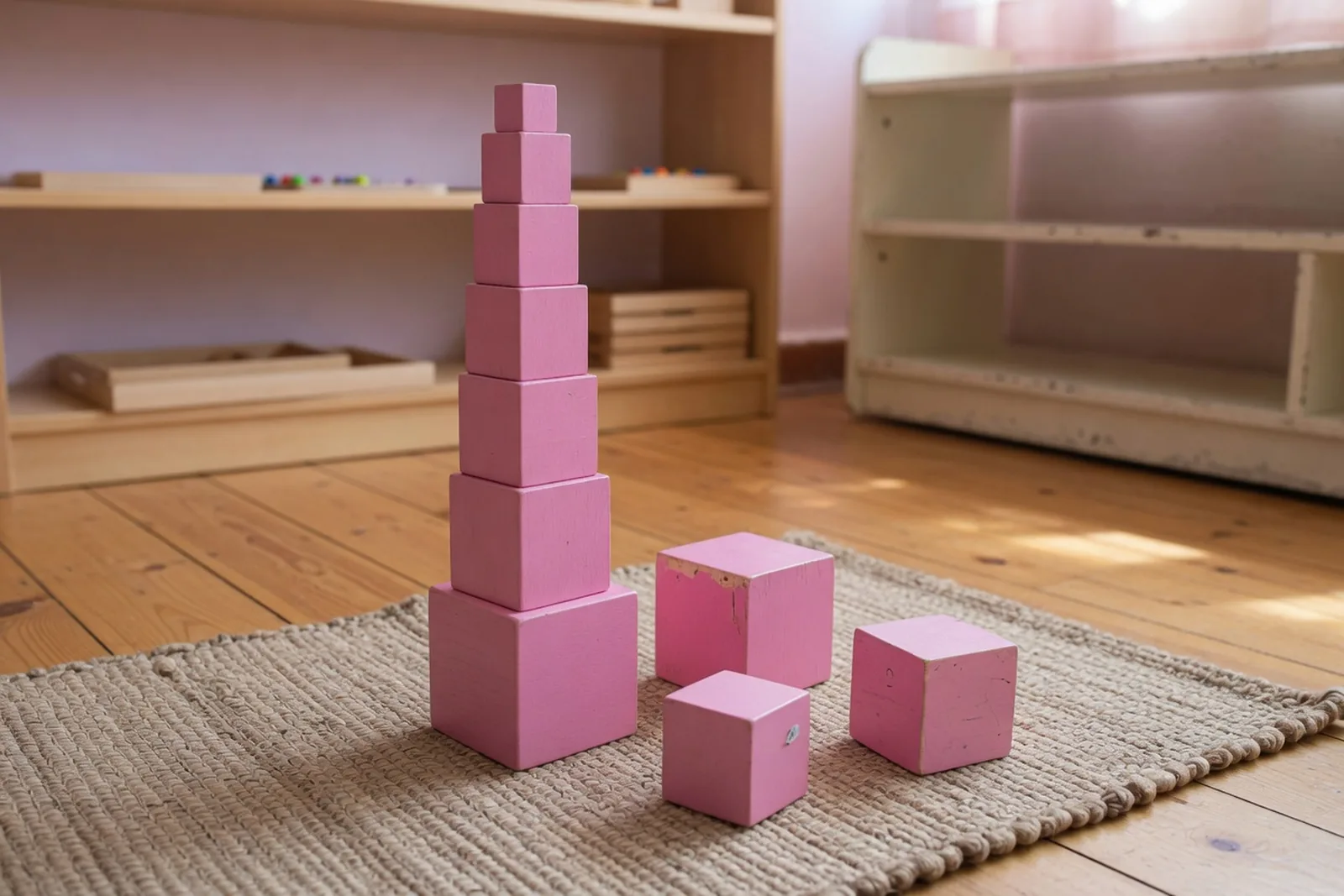
The materials even correct themselves. Build the pink tower out of order and it looks wrong; the child sees it and fixes it, no red pen required. Montessori called this the control of error, and it changes a child's relationship with mistakes. Errors become information, not verdicts.
A toddler who pours her own water becomes a 4-year-old who ties his own shoes, then a 9-year-old who plans her own research week. Independence is not a personality trait. It is a skill, and it compounds.
- Children choose their own work & carry it through to completion
- Materials reveal errors on their own, so feedback is instant & private
- Guides demonstrate once, then step back & observe
- Confidence comes from real competence, not from praise
Concentration
A room built to protect deep focus.
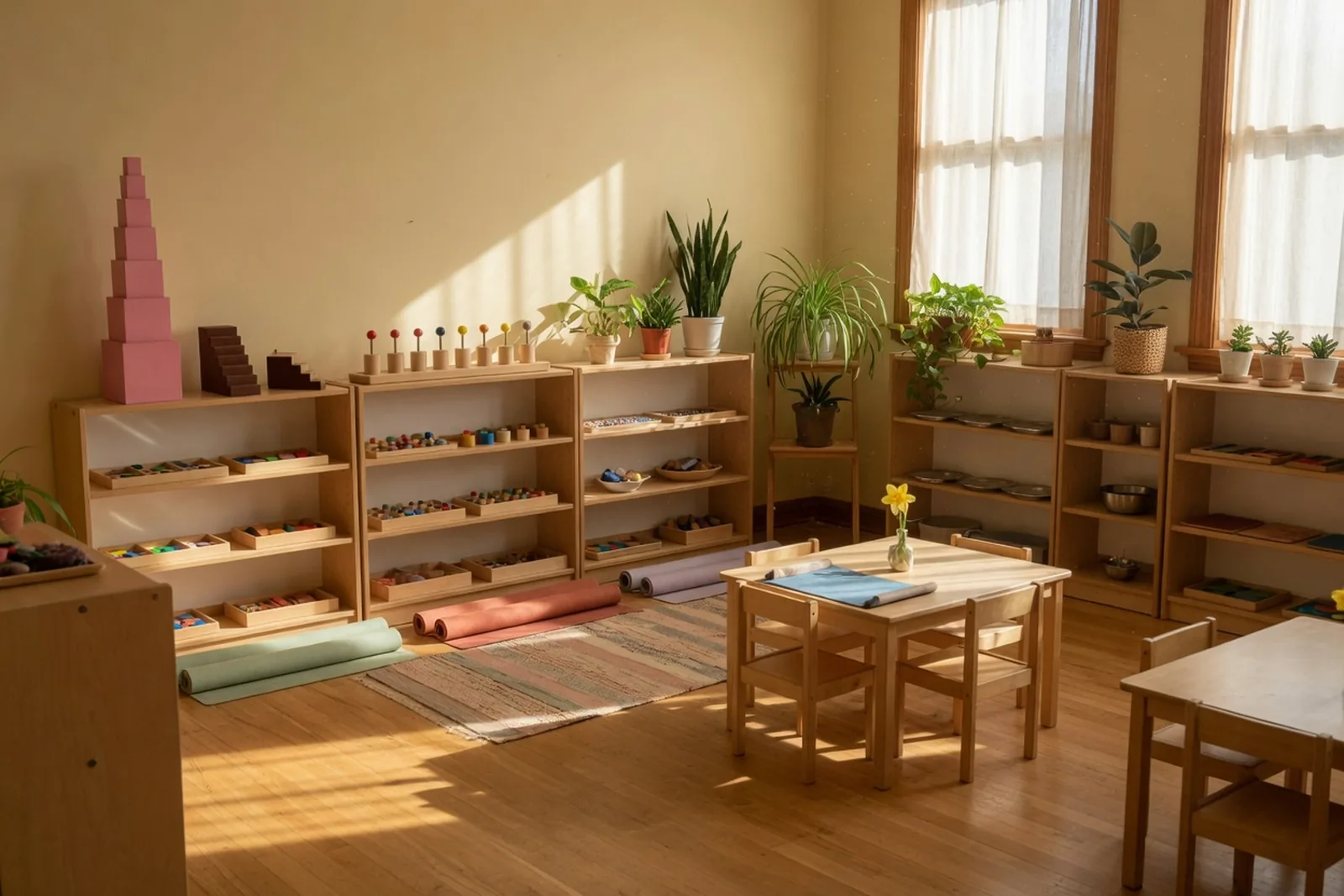
Walk into a classroom mid-morning and the first thing you notice is the hum: quiet, busy, self-directed. That is not luck. It is the prepared environment, Montessori's term for a room where every object has a purpose, a place, & a child-sized scale.
The schedule protects focus the same way the room does. Children work through a long, uninterrupted work cycle each morning. No pull-outs, no bell every 40 minutes. Concentration behaves like a muscle: given time and protection, it grows, and it transfers to everything a child does afterward.
One detail visitors often miss: there is exactly one of each material. Children learn to wait, to plan an alternative, and to respect someone else's work in progress. The room teaches patience without a single lecture on patience.
Motivation that does not need stickers
Most classrooms run on external rewards: grades, gold stars, and prize boxes. Montessori runs on the reward that was already there. Watch a 4-year-old finish the hundred board, sit back, and simply look at it. Nobody claps. Nobody needs to.
Decades of motivation research point in the same direction: external rewards can crowd out interest in the task itself. Montessori children work because the work is interesting, sized to their ability, and chosen by them. That is why the habit survives long after a prize box would have run empty.
Executive function, rehearsed daily
Executive function is the set of skills psychologists link most strongly to long-term outcomes: holding a plan in mind, resisting impulse, and adapting when something changes. A Montessori morning rehearses all three, by design. A child selects a work, carries it to a mat, completes a multi-step sequence in order, handles the small frustration of an error the material reveals, and restores everything for the next person. That is a planning exercise, a working-memory exercise, & an impulse-control exercise, repeated by choice, every day. We go deeper on the mechanism in how Montessori builds executive function.
What the research says
Montessori is one of the few school models old enough, and consistent enough, to study properly. Peer-reviewed studies, including Angeline Lillard's well-known comparisons of Montessori and conventional classrooms, have associated well-implemented Montessori programs with strong academic outcomes alongside stronger social understanding, executive function, and intrinsic motivation. We will not paste cherry-picked statistics here, because the honest finding is more useful than any single number: the size of the effect tracks the fidelity of the program. A faithful Montessori classroom looks very different from a preschool that bought a few wooden materials, and the research keeps finding that the difference matters.
That is exactly why we run full three-year cycles with trained guides and real materials rather than a Montessori-flavored version of a conventional preschool. It is also why the most useful thing we can hand a touring parent is not a study but a list of questions to ask any school, ours included: see real versus fake Montessori, the questions to ask.
But will my child be ready for a conventional classroom later?
This is the question affluent parents ask last, if at all, and worry about most. Many families here expect their child to move on to a competitive public or private school at some point, so the quiet fear is that Montessori will leave a child behind, out of step with worksheets and raised hands. The honest answer is that the skills Montessori builds are the ones that travel. A child who can plan her own morning, stay with a hard problem, and recover from a mistake adapts to a new room faster, not slower. What she has to adjust to is the format, the bell, the desks, and the homework, and children absorb a new format in a few weeks. The reading fluency, the math sense, and the self-direction underneath it took years, and they go with her. Our kindergarten year in particular is built as that bridge, which is why so many of our graduates walk into first grade reading and ready to lead. We lay out the evidence in Montessori and kindergarten readiness.
The method has also had a century to fail, and it has not. If you want the longer story, from Maria Montessori's first classroom to the present, read our history of Montessori. New to the vocabulary entirely? Start with our plain-English primer, What is the Montessori method?
Mixed ages, real social maturity
Every classroom spans 3 years. Younger children watch work they will grow into; older children consolidate what they know by teaching it. Leadership is not a poster on the wall. It is simply what the oldest children in each room do all year.
The results show up in the places parents actually notice: a 5-year-old who welcomes a new classmate without being asked, an 8-year-old who negotiates instead of melting down. Social maturity, like independence, is practiced here, not assigned.
Principles are easy to write and harder to run. To see how each one translates into an ordinary Tuesday in our Chantilly classrooms, read how we practice Montessori, or come watch a morning happen.
Common Myths
Three things Montessori is not.
"It's unstructured."
The opposite. Structure is everywhere: in the sequence of the materials, the ground rules of the room, & the guide's daily record of every child's progress. What is missing is one adult broadcasting the same lesson to every child at once. Freedom here operates inside firm, visible limits.
"It only suits certain kids."
Montessori gets mislabeled as only for the quiet, or only for the gifted. In practice, the method meets each child at their own pace by design. Energetic children get purposeful movement, cautious children get time, and quick learners get an open ceiling instead of a waiting room.
"It's not academic."
Montessori children meet reading, writing, & mathematics early, through the hands first. Sandpaper letters lead into writing, golden beads and the stamp game make the decimal system something you can hold, and the binomial cube quietly rehearses algebra a decade before its name. The academics are rigorous. They just do not arrive as worksheets.