Ages 6 to 12
Elementary
Around age 6, children stop asking what and start asking why. Elementary meets that shift with big lessons, real research, and academics with no ceiling.
The second plane
The age of why.
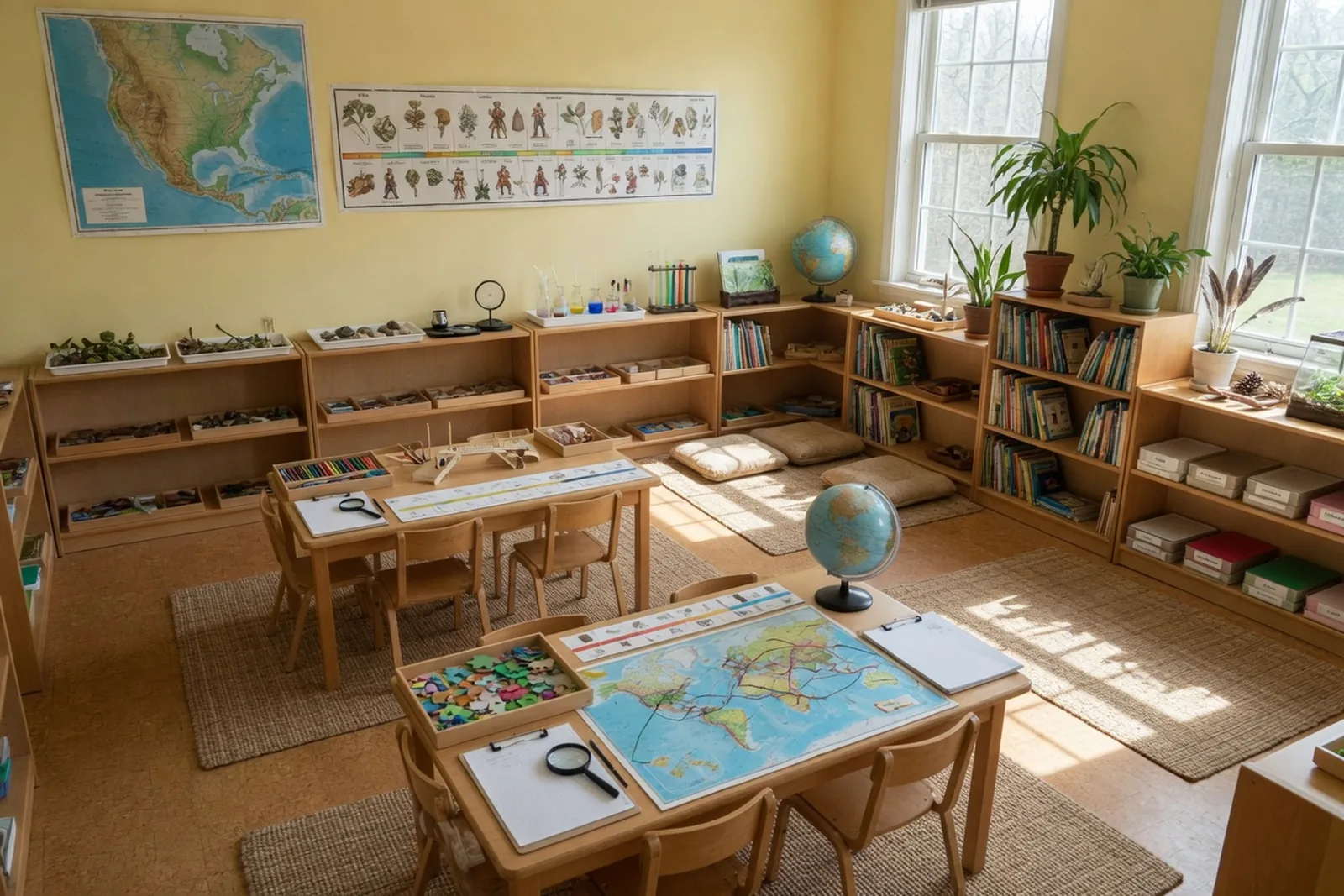
Around age 6, the child changes. The one who was happy to pour, sort, and name things now wants reasons. Why did Rome fall? Why do whales breathe air? What counts as fair? Maria Montessori called these years the second plane of development and built an entire curriculum around the elementary child's appetite for causes, connections, and big ideas. We have taught that curriculum in Chantilly since 1997.
Elementary at MSOFx serves children ages 6 to 12. It sounds different from our younger classrooms: more discussion, more collaboration, and work organized around research rather than repetition. The fastest way to understand it is to watch a morning happen. Schedule a Visit and we will seat you at the edge of one. Elementary families drive in from across the towns we serve in Fairfax County and eastern Loudoun.
Cosmic education
Five great stories, then a year of questions.
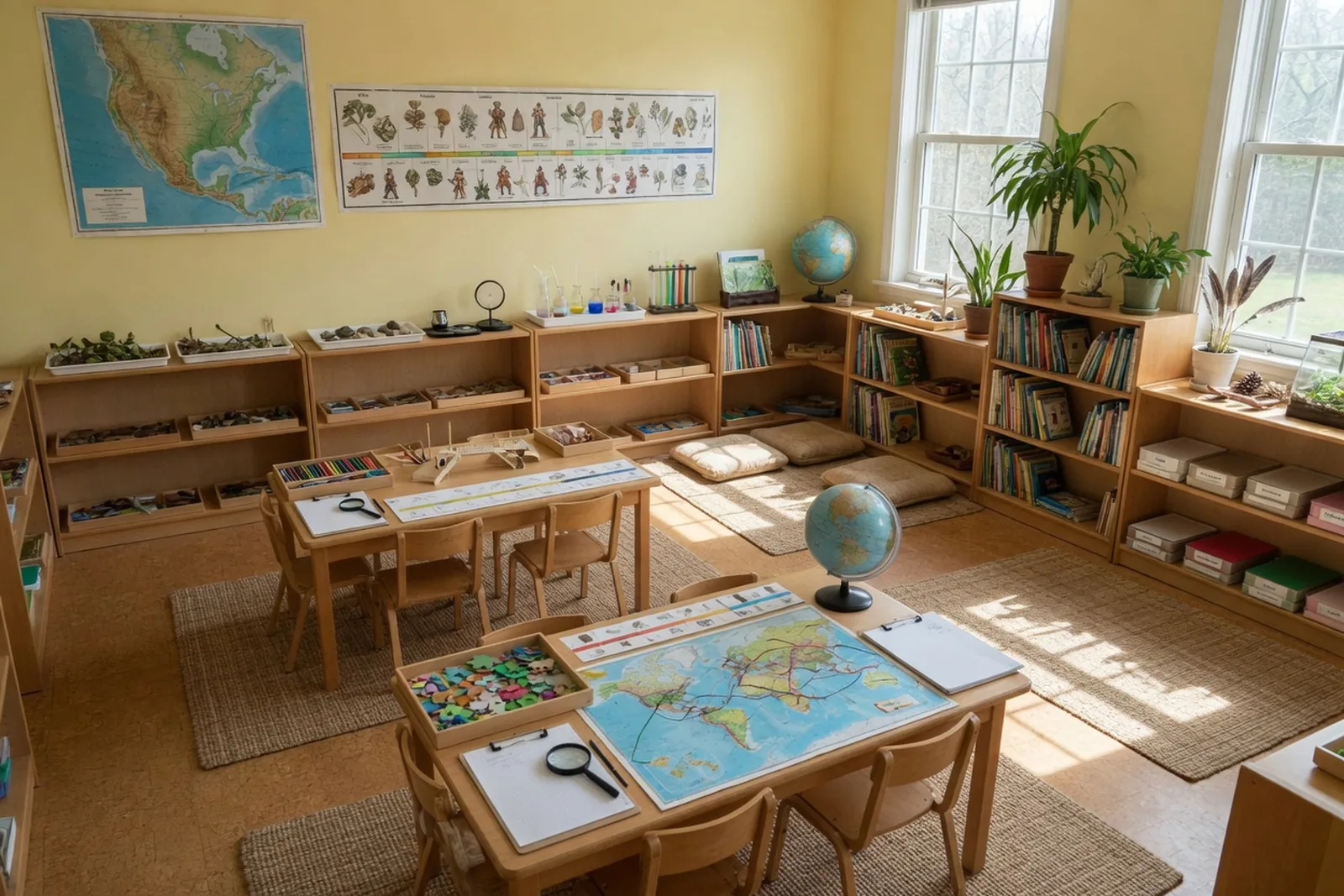
Each Elementary year opens with the Great Lessons: sweeping tellings of how the universe, life, humans, writing, & numbers came to be.
These are not lectures to memorize. They are provocations. A child who hears the story of writing wants to know who carved the first alphabet, and is deep in research on Phoenician traders by Tuesday. Guides then give the specific lessons (fractions, grammar, taxonomy, and timelines) as each child's questions call for them.
The result is a curriculum with a spine. Every subject connects back to one of the five stories, so the child studying volcanoes knows she is still studying the same Earth from the first Great Lesson, not a random chapter in a random workbook. Montessorians call this cosmic education: the habit of placing every fact inside a bigger picture.
Going out
When research outgrows the classroom, they leave it.
A small group studying watersheds may need a nature center. A group staging a play may need the public library. In the Montessori going-out tradition, the logistics are the lesson: children make the phone call, check the hours, plan the route, and account for the budget. An adult accompanies the trip; the children run it.
Ask a 9-year-old here about the last going-out trip and you will not hear about a field trip that happened to them. You will hear about an expedition they built.
Academics
No grade-level ceiling, no grade-level floor.
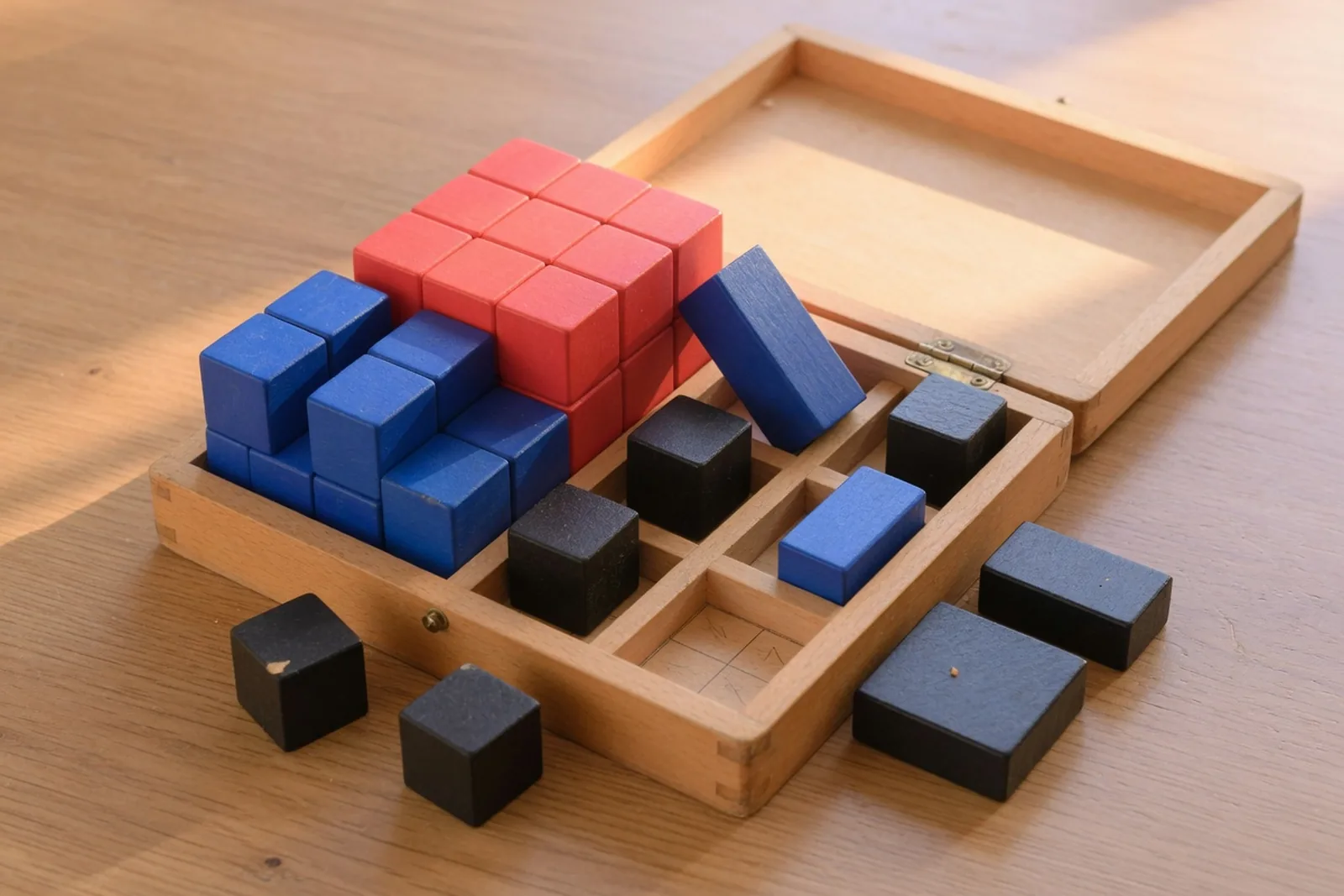
Montessori materials carry a child from concrete to abstract at the child's own pace, and that cuts both ways. The binomial cube your child stacked as a sensorial puzzle at 4 returns in Elementary as algebra: the same blocks, now proving the formula for (a + b)³. Long multiplication moves onto the checkerboard, long division onto the racks and tubes, and a child works the quantity with their hands until the paper version is simply the faster way to say what they already understand.
A 7-year-old ready for long division does long division. An 8-year-old who needs another month with fractions takes the month, without a label and without falling behind an arbitrary schedule. Guides record every lesson against grade-level benchmarks, so depth never comes at the cost of coverage.
Self-management
Work contracts, not busywork.
Elementary children plan their week in writing. Each child drafts a work plan, agrees on it with the guide, and then manages their own time against it: which subjects come first, which projects need a partner, and what is due when. The guide holds the standard; the child holds the pencil.
This is executive function practiced daily, not laminated on a wall. We wrote up the mechanics in how Montessori builds executive function.
- A written work plan the child drafts and the guide approves
- The child's own record of lessons taken and work completed
- One-on-one conferences to review progress and set new goals
- Freedom that expands as responsibility is demonstrated
Classroom communities
Mixed ages, by design.
Elementary children work in mixed-age communities, Lower Elementary for ages 6 to 9 and Upper Elementary for ages 9 to 12. A 6-year-old arrives in a room where 8-year-olds already model the work plan. Three years later, she is the one teaching it. Full three-year cycles mean every child spends time as the youngest, the middle, and the leader.
The community stays small on purpose. With about 130 students in the whole school, every adult in the building knows your child, and our Kindergarten year feeds naturally into Lower Elementary. For working families, Enrichment & After-Care wraps the school day on both ends.
Questions
What parents ask about Elementary.
How does a Montessori elementary program cover Virginia state standards?
The Montessori elementary curriculum covers, and in most subjects exceeds, what Virginia expects at each grade level. Guides keep a written record of every lesson and follow-up, so we always know where each child stands against grade-level benchmarks and can show you at any conference.
Do Montessori elementary students get enough socialization?
Elementary is the most social stage of Montessori. Children choose to work in small groups, plan going-out trips together, and mentor younger classmates every day. With about 130 students in the whole school, your child is known by name in every room.
How do children transition to middle school after age 12?
By 12, Elementary students have planned multi-week projects, met deadlines they set themselves, kept their own work records, and presented research to an audience. Those are the habits middle school runs on, and they transfer whether your family chooses a public or private school next. We also talk with parents well before the move, so placement never sneaks up on you.