How Children Learn to Read in Montessori
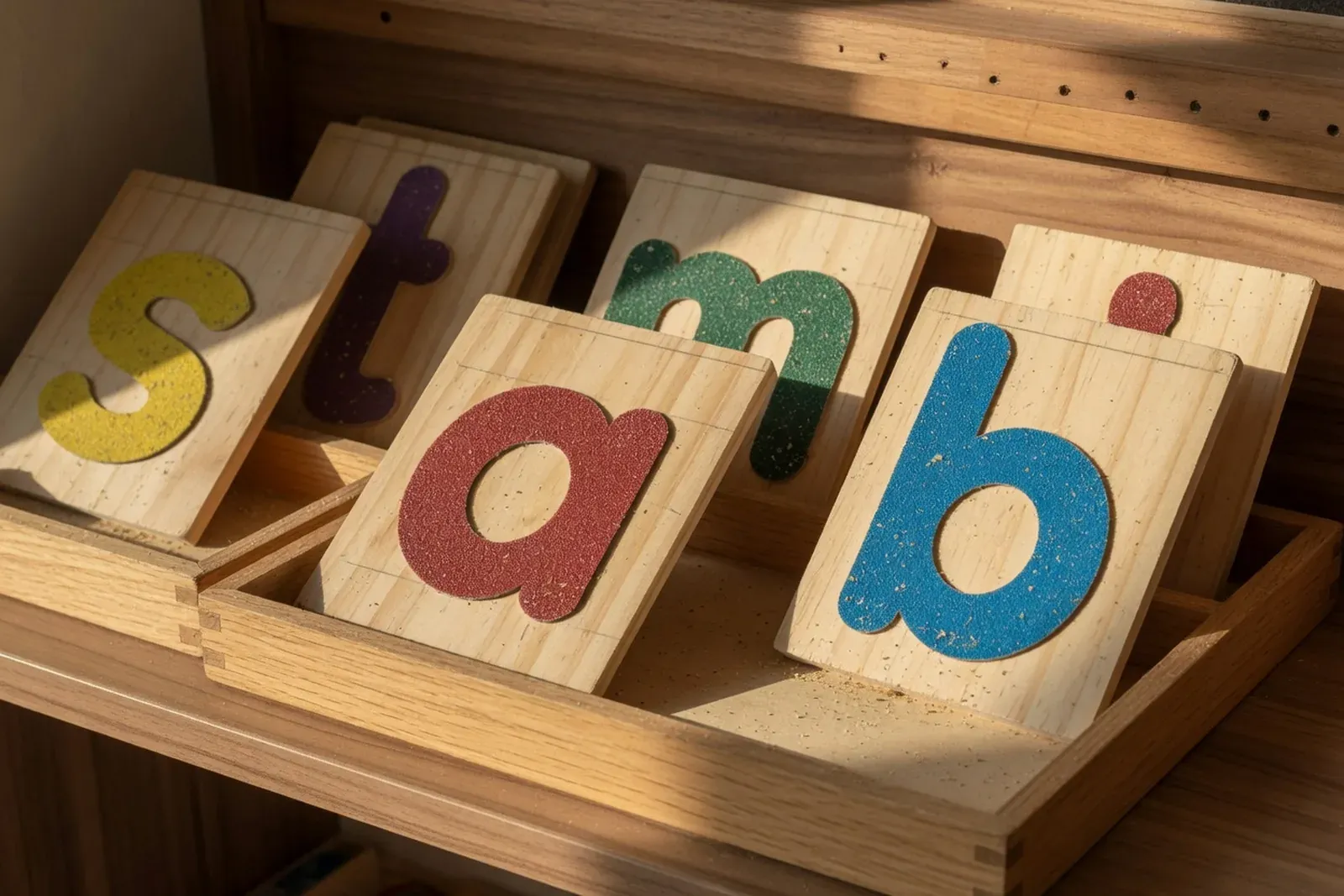
The question beneath most parents' questions about reading is simple: will my child learn to read, and will the process feel joyful rather than pressured? It is a fair question. Reading opens the door to so much of school, and every parent has heard a different story about when it should happen.
In a Montessori classroom, reading does not begin with a worksheet or a list of sight words. It begins with listening. Children notice the sounds inside spoken words, connect those sounds to symbols they can touch, and use letters to build words of their own. By the time a child starts reading from a book, the code of print has already become familiar.
First, children learn to hear the sounds in words
Before children can match a letter to a sound, they need to hear that sound clearly. This is phonemic awareness, or the ability to notice and work with the individual sounds in spoken language. It can look wonderfully ordinary: a guide asks what sound starts sun, a child sorts small objects by their first sound, or a group stretches out the sounds in a word as they play a listening game.
These activities help children separate the sounds of speech from the meaning of a whole word. A child who can hear that map begins with /m/, ends with /p/, and contains three distinct sounds has an important foundation for decoding later. There is no need to rush to printed words while this listening work is still developing. The ear comes first.
In Montessori, the language is concrete. Guides often say the sound a letter makes, not only its letter name. A child may learn /m/, /s/, and /t/ before connecting those sounds to the names M, S, and T. That distinction matters when the child begins blending sounds together to read.
Sandpaper letters give sound a physical form
Once a child is ready, sandpaper letters make the connection between sound and symbol tangible. Each letter is cut from textured material and mounted on a smooth board. The child traces the letter shape with two fingers while saying its sound. Eyes see the shape, fingertips feel its path, ears hear the sound, and the voice repeats it.
This is more than a charming classroom material. Tracing gives the child a purposeful movement to pair with the symbol. It also starts to prepare the hand for writing. Rather than asking a 4-year-old to remember an abstract mark on a page, the material offers a repeatable, sensory experience.
Metal insets do the complementary work. A child traces the inside of a geometric frame with a metal stencil, then fills the outline with a colored pencil, moving the pencil from the shoulder to the wrist to the fingers as control develops. Reading and handwriting are related skills, but they are not the same skill, and a Montessori classroom builds them side by side rather than assuming a child who can sound out a word can automatically hold a pencil steady enough to write it.
A guide presents a few letters at a time, watches closely, and follows the child's readiness. Children return to the letters independently, often choosing the ones that help them write a friend's name, label a drawing, or make the first sound of a favorite animal. Repetition comes from real interest, not from a timer.
Writing often comes before reading
This surprises many adults because we tend to picture reading as the first language milestone. In Montessori, children frequently begin by encoding words, or putting sounds together to write them. The moveable alphabet makes this possible before pencil control is fully mature.
With a box of individual letters, a child can say a word slowly, listen for each sound, and select the matching symbols. A child who wants to write cat might lay out c, a, and t on a mat. At first, spellings may reflect what the child hears rather than conventional spelling. That is useful information, not a mistake to hide. It shows that the child is analyzing the sounds in the word.
Writing with the moveable alphabet gives children agency. They can compose a label, a message, a list, or a tiny story without waiting for perfect handwriting. As their hands strengthen through practical life work, drawing, and tracing, pencil writing joins the process. Their spoken language, sound knowledge, hand movement, and ideas begin to work together.
Curious what this looks like in a real classroom?
Schedule a VisitThen comes the explosion into reading
At some point, often after many small pieces have been practiced, a child begins to blend sounds smoothly. /m/ /a/ /t/ becomes mat. The moment can look sudden, which is why Montessori educators sometimes call it an explosion into reading. But it is not magic, and it is not a race. It is the visible result of work the child has been doing for months.
Early reading materials give children words they can decode, then short phrases and books that let them use the skill with increasing ease. A guide can introduce a new sound pattern when it is useful, offer a book that fits the child's current practice, or step back when the child is absorbed. Comprehension stays central. Reading is not merely saying sounds correctly. It is making meaning from what is read.
Children do not all arrive at this point on the same calendar. Some are ready to blend and read early. Others need more time with spoken language, sound games, or letter work. A prepared classroom makes room for that variation while keeping the next meaningful step close at hand.
How this connects with the science of reading
The science of reading brings together decades of research on how children learn to read. Its findings emphasize several ingredients: phonemic awareness, phonics, accurate and fluent word recognition, vocabulary, language comprehension, and practice with meaningful text. Montessori language work addresses many of the same foundations, using materials that let children work with them actively.
Sound games build phonemic awareness. Sandpaper letters and the moveable alphabet make phonics concrete. Building words helps children understand the alphabetic principle, that written letters represent the sounds in spoken words. Carefully sequenced reading practice supports accurate decoding, while conversations, stories, and rich classroom language support vocabulary and comprehension.
The approaches are not in conflict. The important question is whether a child receives clear, systematic experience connecting sounds and symbols, along with enough spoken language and reading practice to understand what print says. Montessori offers that work through the hands, the voice, and repeated choice.
What parents can watch for at home
You do not need to recreate a classroom at the kitchen table. Read aloud often, even after your child begins reading independently. Talk about interesting words. Sing songs, notice rhymes, and invite your child to listen for the first sound in a name or familiar object. Keep it light enough that your child can stay curious.
When your child brings home an invented spelling or slowly sounds out a word, pause before correcting every detail. Ask what they wrote, celebrate the sounds they heard, and let the guide help you understand the next step. Confidence and careful instruction belong together.
For a closer look at how this work fits into the classroom, explore the Early Childhood program. The best way to understand the sequence is to see a child choose a letter, build a word, and return to the work with real purpose.