Montessori Math: From Golden Beads to Abstraction
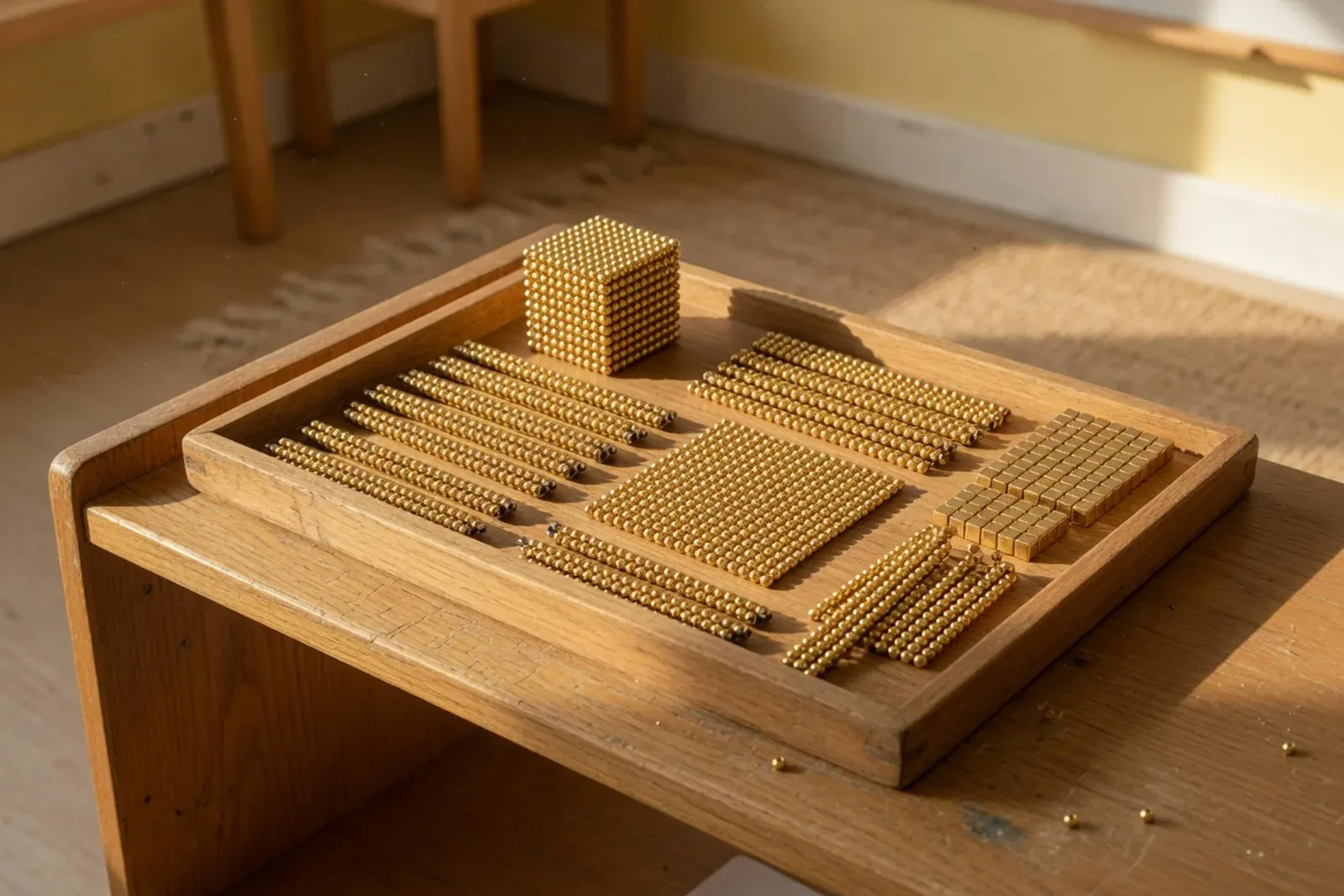
If you have ever watched your child freeze at a page of equations and wondered, “When did math become something to fear?” you are asking an important question. Most math anxiety does not begin because a child cannot think mathematically. It begins when symbols arrive before the ideas behind them have had time to settle.
Montessori mathematics takes the longer, more sensible route. Children first touch quantity, move it, compare it, and make mistakes they can see. The written numeral comes alongside that experience, not ahead of it. By the time a child is working mentally, the numbers are not mysterious marks on a page. They represent relationships the child already knows.
Why abstraction can feel like a leap
Adults use abstract math all day. We see “347” and understand it instantly. A young child sees three unfamiliar characters. Asking that child to add 347 and 268 on paper requires several ideas at once: that digits stand for quantities, that a digit’s place changes its value, that quantities can be combined, and that exchanging ten ones for one ten preserves the total.
A worksheet can show the procedure, but it cannot give those ideas weight. Montessori materials can. They slow the work down just enough for a child to notice what is happening. That is not a detour from rigorous math. It is the foundation that makes rigor possible.
Golden beads make place value visible
The golden bead material is one of the clearest examples. A single bead represents one. A bar of ten connected beads represents ten. Ten bars form a square of one hundred. Ten hundred-squares form a cube of one thousand. Each unit looks and feels different, while still belonging to the same decimal system.
A child can hold one bead in one hand and the thousand cube in both hands. That moment matters. “One thousand” is no longer an impressive-sounding word. It is a quantity with size, structure, and a clear relationship to one, ten, and one hundred.
Early work may be as simple as matching numeral cards to bead quantities, then building a number such as 2,436 with two thousand-cubes, four hundred-squares, three ten-bars, and six single beads. The child is not memorizing place value as a rule. The material is showing it. When a guide asks, “What would happen if we added one more ten bar?” the answer can be seen before it is said.
Addition and subtraction become actions
With the golden beads, addition means gathering quantities together. A child builds two numbers, brings like categories into columns, and counts the total. If there are more than nine ten-bars, the child takes ten bars to the “bank” and exchanges them for a hundred-square. Regrouping is not a trick to remember. It is a fair trade the child performs.
Subtraction works in the same concrete way. If a problem calls for taking away more ones than are on the mat, the child visits the bank with a ten-bar and exchanges it for ten individual beads. The familiar paper instruction to “borrow” becomes more accurate: the child exchanges one unit for its equivalent in a smaller category.
The bank game often brings this work to life. Several children may take different roles, such as banker, recorder, or quantity builder. They read a number, collect the corresponding material, make exchanges, and check one another’s work. The conversation is mathematical, but it is also social and practical. A child has to organize, explain, wait, and notice when an exchange is needed.
Curious what this looks like in a real classroom?
Schedule a VisitThe stamp game carries the idea forward
Once the bead material has done its work, children meet the stamp game. The quantities are represented by small, square tiles marked 1, 10, 100, and 1,000. The material takes up less space and moves more quickly, but it still keeps each category visible. A child can lay out a problem, combine the stamps, and exchange ten of one category for one of the next.
This is a meaningful transition. The child is doing the same reasoning with a representation that is less physically descriptive. The thousand is no longer a large cube, yet the child knows what the 1,000 stamp stands for because the cube came first. Later, a pencil-and-paper problem becomes another representation of that same work.
A sensorial material that pays off years later
Long before a child sees an algebra problem, many spend hours with the binomial cube: eight wooden blocks, painted and sized so that only one arrangement fits together into a perfect cube. A 4-year-old builds it for the satisfaction of a puzzle that resolves, not for any equation. Years later, an elementary child working with expressions like (a + b)³ can discover that the cube they assembled as a preschooler was a physical model of that formula all along. Nobody explains algebra to a preschooler. The hand simply becomes familiar with a pattern the mind will meet again on paper.
From materials to mental math
The goal is never to keep a child dependent on materials. The goal is to give the child a dependable path away from them. As understanding grows, a guide may invite a child to record more of the work, predict an answer before checking with materials, or choose the shortest tool that still makes sense.
You might see a child begin with beads, move to stamps, then solve with a written algorithm. Another child may return to a material after meeting a new kind of problem. That return is not a setback. It is a thoughtful choice to make an idea visible again.
Eventually, many calculations happen mentally because the child has internalized the relationships. Ten ones make a ten. Ten tens make a hundred. A number can be broken apart and recombined without changing its value. Mental math is not guesswork or speed for its own sake. It is flexible thinking built on a clear picture of quantity.
What parents can look for at each stage
At the beginning, look for purposeful repetition. Your child may count the same bead bars, match the same numerals, or build the same numbers many times. Repetition lets a new idea become familiar through the hands.
In the middle stages, listen for precise language. Children may talk about units, tens, hundreds, exchanges, and categories. They may use a material to check an answer they already suspect. This is where confidence often grows because mistakes are information, not evidence that a child is “bad at math.”
Later, look for explanation. A child who can say why an answer makes sense has more than a memorized method. In an Elementary classroom, that foundation supports larger operations, fractions, geometry, measurement, and the kind of multi-step problem solving that asks children to choose a strategy, not simply repeat one.
A useful question to ask at home
When your child brings home a math problem, try asking, “Can you show me what this means?” instead of “What is the answer?” Buttons, coins, beans, a drawing, or a number line can all help. The point is not to recreate a classroom lesson at the kitchen table. It is to make room for thinking out loud.
Math becomes less intimidating when children learn that an answer has a story. Montessori materials give that story a physical beginning. The symbols come later, carrying meaning instead of asking children to supply it on faith.