Montessori vs. Traditional Preschool: An Honest Comparison
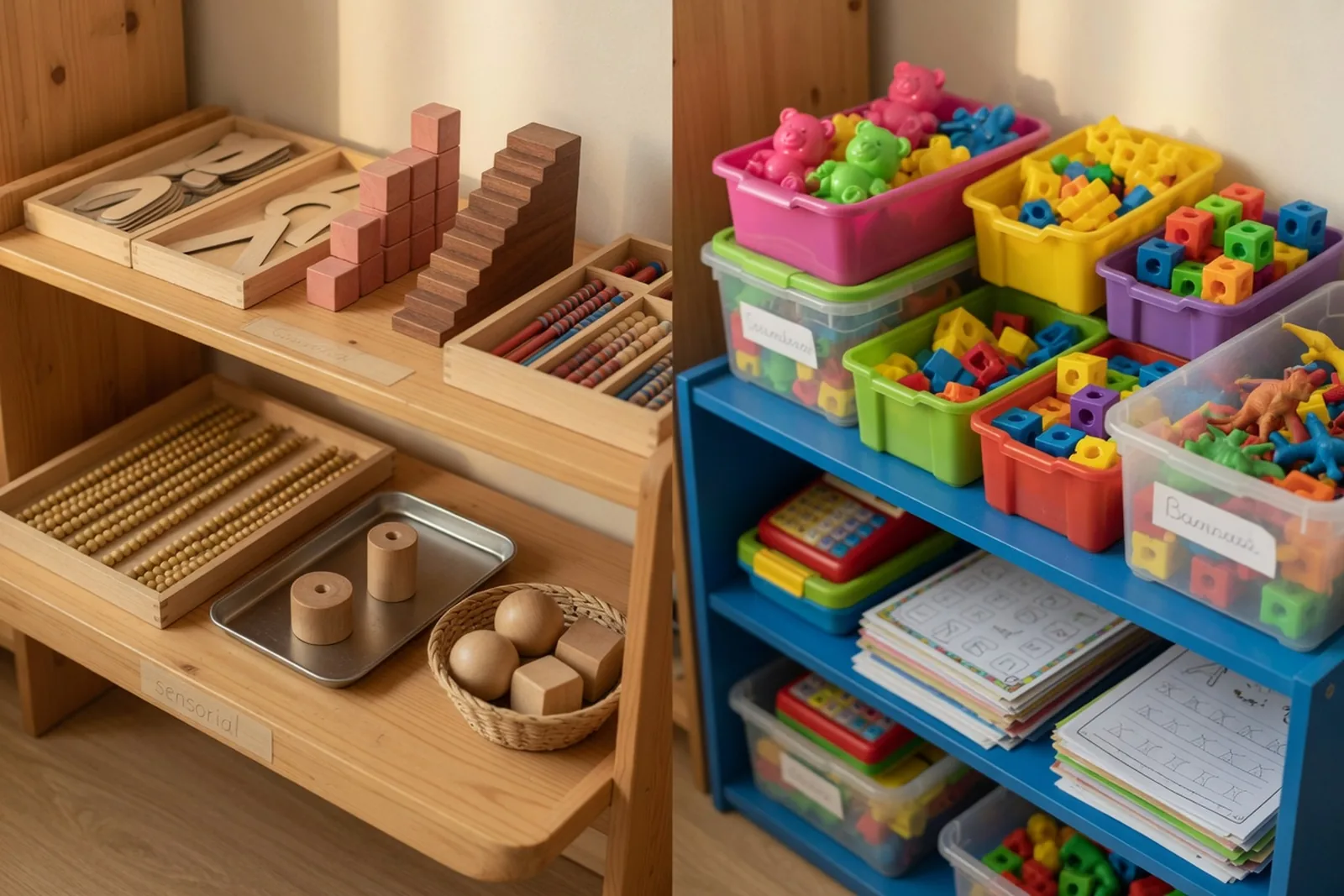
When you compare Montessori with traditional preschool, you are usually not asking which label sounds better. You are asking where your child will be understood, what their days will feel like, and whether the school will help them grow without asking them to become someone else first.
Both approaches can give children friendship, language, routines, and caring adults. The meaningful differences are in how a classroom is organized, how adults respond when a child is stuck, and how much room a child has to follow a deep interest. Here is a clear look at each, including the places where traditional preschool may be the better fit.
The differences at a glance
| What you notice | Montessori preschool | Traditional preschool |
|---|---|---|
| Classroom structure | Children choose from a prepared set of purposeful work, often in a mixed-age community. | The class commonly moves together through teacher-led centers, lessons, and transitions. |
| Adult role | The adult observes, gives individual lessons, and protects time for practice. | The teacher leads the group, explains the activity, and sets much of the day’s pace. |
| Materials | Hands-on materials have a specific purpose and invite repetition: sandpaper letters for sound, golden beads for quantity, metal insets for pencil control. | Materials often support a weekly theme, creative project, dramatic play area, or whole-class activity. |
| Pace | A child may stay with one chosen task until they finish, repeat it, or need a new lesson. | The schedule usually changes at set times so the group can move on together. |
| Assessment | Adults keep close observational notes and use what they see to plan the next presentation. | Teachers may use observations, developmental checklists, portfolios, and group benchmarks. |
These are patterns, not guarantees. A thoughtful traditional teacher can make space for choice and individual attention. A Montessori classroom still has clear limits, lessons, and community expectations. The question is what the model makes easiest to do every day.
What a day can feel like
In a traditional preschool, the day often has a visible group rhythm: arrival, circle time, a teacher-led activity, centers, snack, outdoor play, lunch, rest, and another planned activity. For many children, that cadence feels secure. They know when everyone will sing, listen to a story, paint, or head outside. A shared theme can also make family conversations simple: this week is about gardens, community helpers, or the weather.
A Montessori morning usually centers on a long work period. A child might greet a friend, choose a floor mat, polish a small object, build the decimal system with golden beads, trace a metal inset for the pencil control it takes to write later, listen to a reading lesson, and return to an activity they began yesterday. The guide moves through the room, giving a lesson to one child or a small group, noticing who needs support, and inviting a child toward work that is ready for them.
That freedom is structured. Children learn how to carry materials, use them carefully, restore the space, and consider the people working around them. They do not have unlimited choice, but they have meaningful agency within a carefully prepared environment. In an Early Childhood classroom, that can mean a 3-year-old practices buttoning while an older child builds words with a moveable alphabet.
Curious what this looks like in a real classroom?
Schedule a VisitWhere traditional preschool genuinely shines
Traditional preschool is not Montessori’s lesser cousin. It can be an excellent choice when a child enjoys high-energy group activities, thrives with frequent teacher direction, or is happiest when everyone is doing the same thing at once. A strong classroom builds warmth, language, play skills, and confidence through familiar routines.
It may also suit a family seeking a program built around a particular philosophy, such as play-based learning, a faith community, a bilingual setting, or a part-time schedule. Some children find the quick transitions and shared enthusiasm of a group lesson energizing. Some parents value a classroom’s themed art projects, seasonal performances, and predictable take-home work. Those preferences are real, and they deserve respect.
The quality of the adults matters in either setting. Watch whether teachers speak respectfully, whether children can get help without waiting too long, and whether the room has enough order for children to use it confidently. An impressive curriculum cannot make up for adults who rush, shame, or overlook children.
How to decide for your child
Start with observation, not marketing language. Visit while school is in session if you can. In any classroom, ask yourself: Are children engaged? Do adults know what each child is working on? Can you see both warmth and clear boundaries? Is there room for a child to concentrate, move, ask for help, and try again?
Then think about your child’s current needs. A child who watches for a long time before joining may appreciate the chance to choose work at their own pace. A child who loves to lead a chorus of friends may delight in a group-centered program. A child who needs practice with independence may benefit from a room designed for small, real responsibilities. Temperament is useful information, not a verdict. Children change quickly when the environment gives them the right kind of support.
Ask practical questions, too. How does the school handle separation at arrival, conflict between children, toileting, rest, outdoor time, and communication with families? What happens when a child is ready for more challenge, or when they need extra time? The answer should sound specific, calm, and realistic.
What matters most after the label
You do not need to choose Montessori because it is Montessori, and you do not need to reject traditional preschool because it looks more familiar. Choose the school where the daily experience matches what your child and family need now. A good fit gives your child capable work, steady relationships, and adults who pay attention.
If Montessori interests you, spend time in a classroom before deciding. The quiet concentration, the accessible materials, and the way children help one another are easier to understand in person than in any comparison chart.