What Is the Montessori Method? A Plain-English Guide
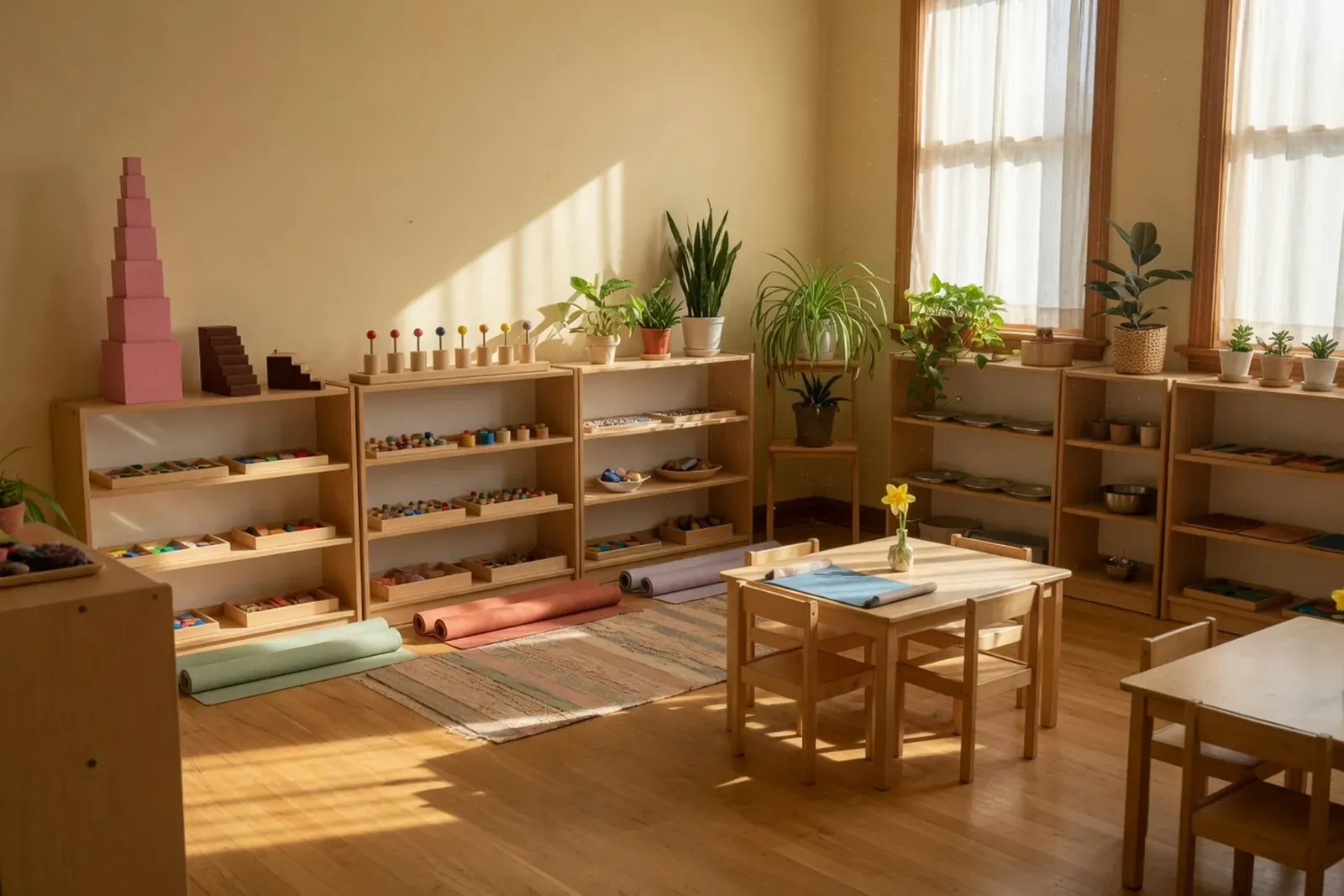
When parents ask, "What is Montessori?" they are rarely looking for a dictionary definition. They want to know what their child will actually do all day, how learning happens without a teacher directing the whole group, and whether the approach will prepare their child for what comes next.
The short answer is that Montessori is a method of education built around careful observation, purposeful choice, hands-on materials, and growing independence. Adults prepare an orderly environment, show children how to use it, and protect long stretches of time for focused work. Children do not simply entertain themselves. They learn to choose from appropriate work, stay with a challenge, and take increasing responsibility for their classroom community.
Where did Montessori begin?
Italian physician and educator Maria Montessori opened the first Casa dei Bambini, or Children's House, in Rome in 1907. She observed how children learned when they could move freely, use materials sized for their bodies, repeat activities, and work with less unnecessary adult interruption. Those observations became a method that schools now use around the world. Our history of Montessori offers a fuller account of how the approach developed.
The five big principles
1. The environment teaches
A Montessori classroom is prepared before children enter it. Shelves are low, materials have consistent places, and each activity has a clear purpose. A child can see what is available, carry it to a table or floor mat, complete it, and return it for the next person. This order reduces friction and lets children act without waiting for an adult at every step.
2. Choice happens within limits
Children choose their work, but the classroom does not offer unlimited options. The guide selects materials that fit the age group, gives lessons when a child is ready, and redirects choices that are unsafe, disruptive, or not yet appropriate. Freedom and responsibility grow together. A child may choose when to practice pouring, for example, but still needs to carry the tray carefully, use it as shown, and clean any spill.
3. The hands lead the mind
Montessori materials make an idea visible and touchable before asking a child to work with it only in symbols. A young child traces a sandpaper letter with two fingers before writing it. That same child later builds quantity into the thousands with golden beads, long before a worksheet asks them to add three-digit numbers. An older child moves from those same beads to the stamp game, then to paper, carrying the concrete relationship with them the whole way. The material is not a shortcut or a toy. It gives the child concrete feedback and a path toward abstraction.
4. Concentration needs protected time
Instead of changing subjects every few minutes, Montessori classrooms protect an extended work period. Children have time to settle in, choose thoughtfully, repeat difficult work, and reach the kind of concentration that cannot be scheduled into a 15-minute block. This uninterrupted work cycle also lets the guide give individual and small-group lessons without stopping everyone else.
5. Mixed ages create a working community
Montessori classrooms typically group children across a multi-year age span. Younger children see where their work can lead. Older children deepen their understanding by modeling routines, answering questions, and taking on real responsibility. Each child can be a beginner in one area and capable in another, which makes progress less about keeping pace with a single-age group.
Curious what this looks like in a real classroom?
Schedule a VisitWhat does a Montessori classroom look like?
You may first notice what is missing. Desks do not all face one teaching wall. The adult is not speaking to the full class for most of the morning. Children are not all completing the same page at the same time.
Instead, you might see one child washing a table, two children building words with a movable alphabet, and another child counting golden beads at a rug. Nearby, a child may be tracing a metal inset with a colored pencil, building the fine motor control that later shows up in handwriting. At the elementary level, you might see a small group receive a geometry lesson built around a binomial cube while classmates research a historical question, revise writing, or solve equations. Movement has a purpose: choosing work, gathering materials, asking for a lesson, or caring for the room.
The materials usually progress from simple to complex and from concrete to abstract. Many include a built-in way for a child to notice an error. A cylinder that does not fit its socket or a bead chain counted incorrectly gives useful feedback without turning every mistake into an adult correction. The child can pause, reconsider, and try again.
What is the adult doing?
Montessori often calls the teacher a guide because the role centers on connecting each child with productive work. That does not mean the adult stands back and hopes learning happens. The guide presents precise lessons, observes closely, keeps records, prepares the room, and decides what to introduce next.
The guide also protects the social life of the classroom. Children receive direct instruction in waiting, interrupting politely, resolving conflict, caring for shared materials, and respecting another person's concentration. When a child struggles, the guide considers the source before responding. The child may need a new lesson, more challenge, a simpler step, movement, or help joining the group.
Common Montessori misconceptions
"Children can do whatever they want."
Montessori offers freedom within a carefully maintained structure. Children choose among purposeful options and follow clear expectations for safety, respect, and care of the environment. Guides intervene when a choice falls outside those limits.
"There is no play or creativity."
Montessori distinguishes purposeful activity from adult-created busywork, but creativity remains central. Children compose stories, draw, sing, build, investigate, imagine possibilities, and solve open-ended problems. Classroom practices around fantasy play can vary by age and school, so this is a useful topic to ask about during a visit.
"Children work alone all day."
Independent concentration matters, especially in the early years, but Montessori classrooms also include partner work, small-group lessons, conversations, shared meals, and community responsibilities. As children grow, collaboration becomes increasingly visible and complex.
"Montessori is unstructured or not academic."
The structure lives in the sequence of materials, the guide's lessons, the classroom expectations, and the child's work plan, not in constant whole-class direction. Reading, writing, mathematics, science, geography, history, art, and practical skills develop through carefully sequenced experiences. You can read more about that sequence in our overview of the Montessori method.
What should you look for when you visit?
Watch the children more than the decor. Are they making real choices or waiting for directions? Can they find, use, and return materials independently? Do adults observe before stepping in? Does the room feel calm because children are engaged, or merely quiet because they are tightly controlled?
Ask how guides track progress, introduce new work, respond when a child avoids a subject, and support transitions to other schools. Ask how long the work cycle lasts and how mixed-age groupings function. A school should be able to explain the purpose behind what you see in clear language.
Montessori is not one particular room design or a collection of wooden materials. It is a coherent way of thinking about development: prepare carefully, observe closely, teach precisely, and give children room to do meaningful work for themselves.