The Three-Hour Work Cycle, Explained
You may have heard that Montessori classrooms have a three-hour work cycle and wondered what, exactly, a young child does for three hours. Surely no 3-year-old sits still that long. And why would a school avoid the tidy schedule of circle time, centers, snack, and the next activity?
The short answer is that a work cycle is not three hours of one assignment. It is a protected stretch of time in which children choose purposeful work, repeat it, put it away, ask for help when they need it, eat when the classroom routine allows, and gradually find work that asks more of them. The length matters because concentration rarely arrives on command.
What a three-hour work cycle is
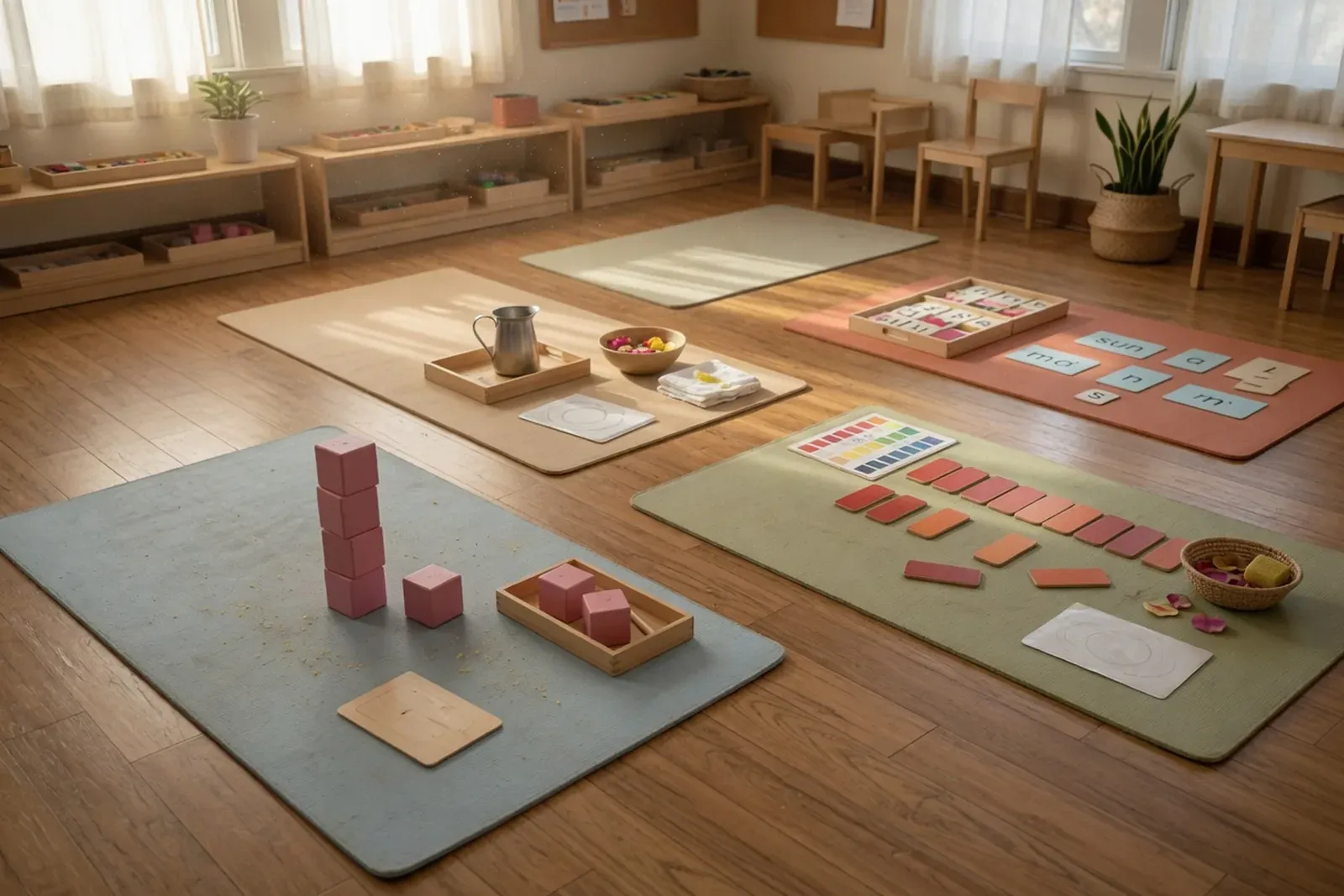
In a Montessori classroom, the morning is arranged around a long block of uninterrupted work. A child might begin by pouring water from one small pitcher to another, then roll out a mat for the pink tower, then join a friend for a language lesson. Another child may spend forty minutes writing with a moveable alphabet. The guide gives individual or small-group lessons, observes, and connects each child with the next useful challenge.
There is movement, conversation, cleanup, choice, and work at many levels in the same room. What there is not, ideally, is a bell that asks everyone to stop just as someone has become absorbed. The room has a rhythm, but it does not require every child to do the same thing at the same minute.
This is different from unstructured free play. The environment is prepared with materials that have a clear purpose, a beginning and an end, and a place on the shelf. Children have meaningful choices within clear limits. They can return to a work many times because repetition is how a new skill becomes their own.
Why concentration needs protection
Adults know the feeling. You spend the first part of a task answering messages, locating what you need, and getting settled. Then, after a while, the work starts to click. Children have the same warm-up period, often with more physical movement and more visible trial and error.
When an adult interrupts that process too soon, the child loses more than a few minutes. They lose the chance to discover, "I can stay with something that is hard." That discovery is a quiet source of confidence. It grows when a child solves a problem, makes a correction, or completes a sequence without having the answer supplied immediately.
A protected block also lets the guide see what is real. A child who appears restless during a whole-group lesson may settle into careful work once they can choose a material and move their body. A child who finishes quickly may be ready for a deeper lesson, not another worksheet. Observation works best when there is enough time for patterns to appear.
The 10:00 a.m. wobble is not always fatigue
Many parents recognize the midmorning dip. A child drifts, complains that they are tired, or abandons one thing after another. It is tempting to read that moment as proof that they need a new activity, a snack, or an adult to entertain them.
Sometimes they do need those things. But often it is a transition point, not true fatigue. The first easy choices are finished. The next work asks for more coordination, more patience, or more courage. In a classroom built around quick rotations, the schedule rescues the child from that discomfort. In a long work cycle, a guide can offer a small invitation: "Would you like me to show you the first step?" Then the child can decide whether to continue.
That pause is valuable. Children learn that boredom, uncertainty, and frustration are not emergencies. They can take a breath, look around, choose again, and re-enter their work. No one needs to force a child through a hard task. The environment simply gives them enough time to meet it.
What it replaces: the activity carousel
Many early-childhood schedules are built as a carousel: one adult-led activity follows another, with frequent transitions to keep the group moving. This approach can look busy and productive. It also asks children to practice stopping, switching, and waiting all day long.
Montessori does not reject group time, stories, music, outdoor play, or shared meals. Those experiences have a place. The difference is that they do not crowd out the longest, most valuable period of self-directed work. Instead of measuring a morning by how many activities fit into it, the work cycle asks a better question: did each child have time to become engaged?
For a closer look at how those pieces fit together, see a day in the life at MSOFx. The schedule includes transitions, but the work period has room to breathe.
Curious what this looks like in a real classroom?
Schedule a VisitWhy the habit matters far beyond preschool
Deep focus at age 4 does not look like deep focus at age 14. At 4, it may be a child returning to a pouring work until every drop lands in the bowl, completing a puzzle map, or sounding out a label with the moveable alphabet. Their concentration is physical, visible, and often brief at first.
At 14, the same underlying habit can look like reading a difficult chapter without checking a phone, revising an essay after the first draft disappoints them, planning a science project, or staying with a math problem long enough to find an error. No preschool routine can guarantee a teenager's study habits. But repeated experience with choosing work, managing attention, and recovering from difficulty gives a child useful practice long before homework becomes serious. The same child who once spent twenty minutes with the stamp game, working a long addition problem bead by bead and stamp by stamp, is the one who has already practiced staying with a multi-step problem instead of giving up at the first wrong answer.
This is one reason Montessori materials move from concrete to abstract. A child first works with real objects and clear feedback. Later, they carry the same persistence into language, mathematics, research, and collaboration. In the Elementary program, big questions and independent research give that habit a larger canvas.
What you can borrow at home
You do not need a classroom shelf or a three-hour block on Saturday morning to support concentration at home. Start by protecting one small stretch of time. Put away the device that will interrupt you, offer one real task or open-ended material, and resist the urge to improve the experience every five minutes.
For a toddler, that might mean washing berries in a colander, matching socks, or carrying napkins to the table. For an older child, it might be building with blocks, drawing a plan for a fort, cooking a simple recipe, or working through a question they care about. Choose work that has a real result, enough challenge, and a clear place to clean up.
Then watch before you step in. If your child wanders after a few minutes, you can say, "You are deciding what to do next," rather than immediately offering a screen or a new toy. If they ask for help, give the smallest help that lets them continue. If they are truly done, let them finish and restore the space. The goal is not to make home feel like school. It is to show your child that their attention is worth respecting.
Over time, you may notice something reassuring: a quieter room does not mean less learning. Often it means a child has found work that belongs to them.