Why Mixed-Age Classrooms Work
Montessori method
A closer look at the classroom structure that gives children room to lead, learn, and belong.
It is a fair question. If your child is one of the oldest in a classroom, will they spend the year waiting for younger children to catch up? If they are one of the youngest, will they feel lost among children who seem more capable? Parents often hear that Montessori classrooms mix ages and wonder whether that arrangement serves every child, or simply makes scheduling easier.
In a well-run mixed-age classroom, the ages are not an afterthought. They are part of the learning design. Children work in a community that includes people who are new to an idea, people practicing it, and people ready to explain it. That changes what learning feels like. Progress is less like a line of desks moving at the same pace and more like a room where each child has a clear next step.
Children see what is possible
Young children learn constantly by watching. In a mixed-age Montessori classroom, they have many chances to watch peers use a material carefully, choose work independently, resolve a small disagreement, or return something to its shelf. Those examples come from children close enough in age to feel reachable. A 3-year-old may not imitate an adult the same way they imitate a calm 5-year-old carrying a tray with both hands.
Older children offer a different kind of model. They make the expectations of the room visible without turning them into a lecture. A younger child can see that the pink tower has a particular order, that a work mat marks a personal space, and that a friend can ask for help politely. Over time, the classroom culture becomes something children participate in, not something done to them.
Mentorship also runs in both directions. Older children learn patience and perspective when they work alongside younger classmates. Younger children remind older ones that learning begins with curiosity, repetition, and the willingness to try again. A child who has become fluent with a material may notice a beginner's question that an adult would not have thought to ask.
Teaching deepens mastery
There is a particular confidence that comes from helping someone else. When a child shows a younger classmate how to carry a glass pitcher, match sound cylinders, or organize a sentence with a moveable alphabet, they have to slow down and notice the steps. They cannot rely on doing the work automatically. They name what matters, sequence it, and respond to another person's confusion.
That process strengthens understanding. Explaining an idea reveals where a child's own thinking is solid and where it needs another look. It also gives older children a real role in the community. Leadership is not a sticker on a chart. It is the experience of being trusted with work that helps someone else.
This does not mean older children become unpaid assistants, or that younger children receive instruction only from peers. The guide still observes each child, gives individual presentations, and protects time for focused work. Peer learning adds another layer. It makes knowledge social without making the classroom competitive.
Curious what this looks like in a real classroom?
Schedule a VisitThe three-year arc matters
Mixed ages work best when the group stays together long enough to become a real community. Montessori classrooms commonly span a three-year cycle. In the first year, a child learns the rhythms of the room and begins using the materials. In the second, they gain fluency and range. By the third, they often have the confidence to lead, make choices with more purpose, and support others.
That arc gives children time. They do not need to master every skill by a single arbitrary date because the classroom is built for continued growth. A child can revisit a material, extend it when ready, and see how earlier work connects to later work. The older child is not simply finishing a grade. They are experiencing what it means to be a capable member of a group they already know.
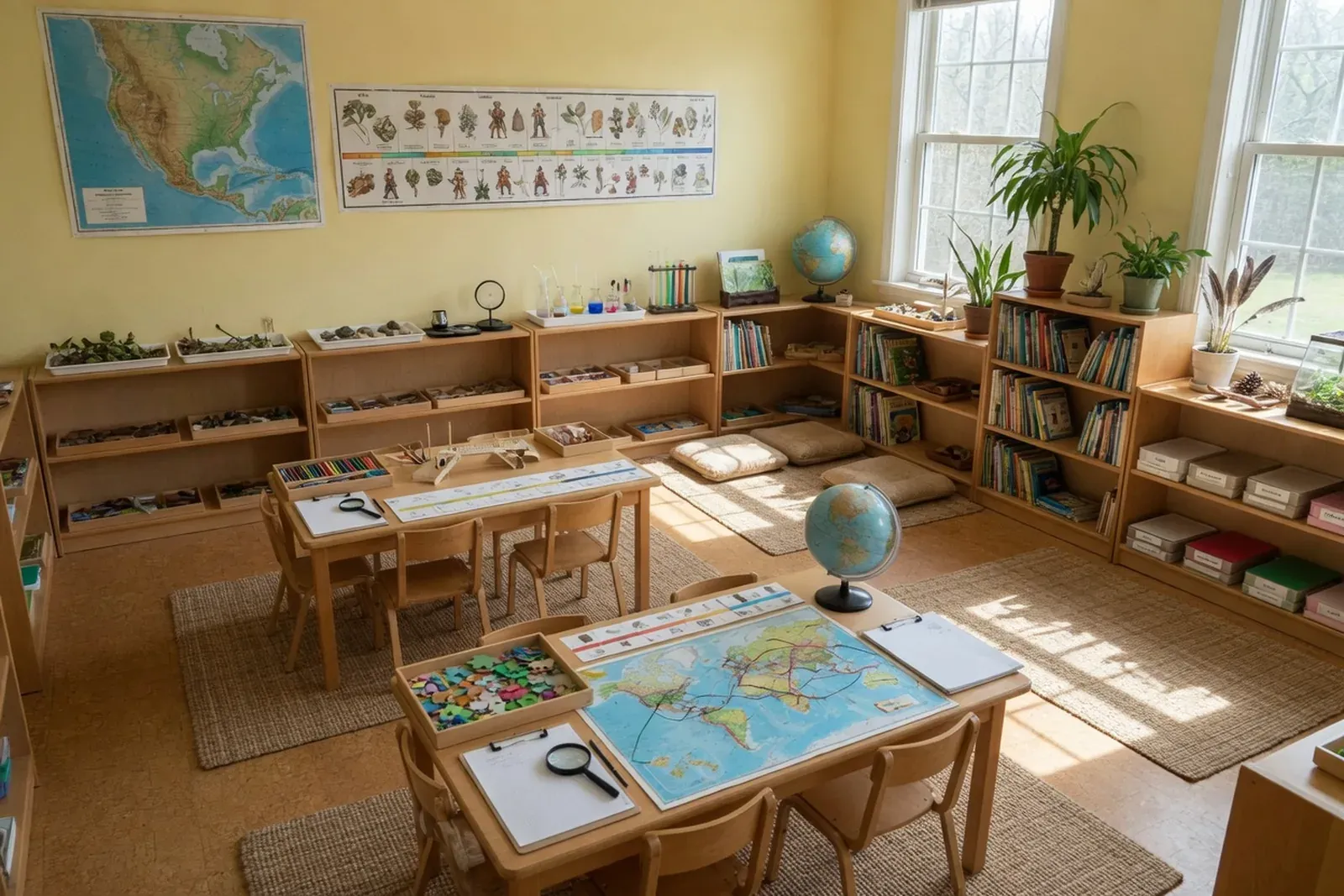
For families considering Early Childhood, this is often one of the most visible parts of the classroom. Children ages 3 to 6 share a prepared environment, but they are not all assigned the same work. A newer child may be practicing pouring and buttoning with a pink tower nearby for size and order, while an older child is reading, composing sentences with the moveable alphabet, or working the stamp game toward four-digit addition. The guide meets each child where they are, then uses the full span of the room as a source of examples and connection.
Social maturity grows through real practice
Children do not develop social skills by hearing adults say, "Be kind," once a day. They develop them through repeated, low-stakes practice. In a mixed-age group, children encounter classmates with different levels of language, confidence, patience, and independence. They learn to wait, ask, negotiate, offer help, and decide when someone needs space.
This is not always perfectly smooth, and it should not be. A minor conflict over a favorite material or a place at a table gives a child a chance to practice a useful response. The adult's role is to observe, guide when needed, and help children find respectful ways forward. Over time, children learn that community means both having a voice and making room for another person's voice.
Older children also learn that competence is not a fixed identity. They may be the expert with one material and the beginner with another. That is a healthy lesson for anyone, especially in a setting where children can otherwise start measuring themselves against classmates on a single scale.
What research suggests
Research on peer learning and cooperative learning generally suggests that children can benefit when they explain ideas, collaborate with classmates, and take responsibility within a group. Studies of mixed-age settings point to potential benefits for social development, confidence, and learning through observation. The details matter, though. Age mixing alone does not create a strong classroom.
The structure around it matters just as much. Children need clear routines, materials that invite independent work, adults who know when to step in, and enough time to concentrate. They need a community where helping is expected but not forced, and where each child's work remains appropriately challenging. That is the difference between a thoughtful mixed-age environment and simply combining several grades in one room.
Will my oldest child be held back?
Usually, this question comes from a good instinct. You want your child to keep growing. In a strong Montessori classroom, older children are not asked to repeat beginner work to accommodate younger classmates. They continue into more complex work, receive presentations that match their readiness, and have time to pursue ideas with greater depth.
What changes is the definition of challenge. Academic difficulty matters, but it is not the only meaningful kind of growth. An older child may stretch by planning a longer project, refining a piece of writing, solving a more involved problem, or learning how to guide a younger peer without taking over. None of that replaces academic progress. It makes academic progress more useful because the child learns how to use what they know.
The practical test is simple: when you visit, look for children doing different work with real concentration. Notice whether older children have materials and questions that meet them where they are. Watch whether younger children move with purpose rather than being managed through the day. A mixed-age classroom should feel active and orderly, not one-size-fits-all.
A classroom that feels like a community
Children spend a great deal of their day at school. It is worth asking not only what they will learn, but what kind of community will teach them. Mixed-age classrooms make room for children to be newcomers, steady contributors, and leaders over time. They experience both receiving help and giving it.
That does not remove the need for skilled guidance or individual attention. It makes both more meaningful. Each child has work that belongs to them, and each child belongs to a group where their presence matters. For many families, that is the part they recognize most clearly when they step into the classroom.