Screen Time and the Montessori Home
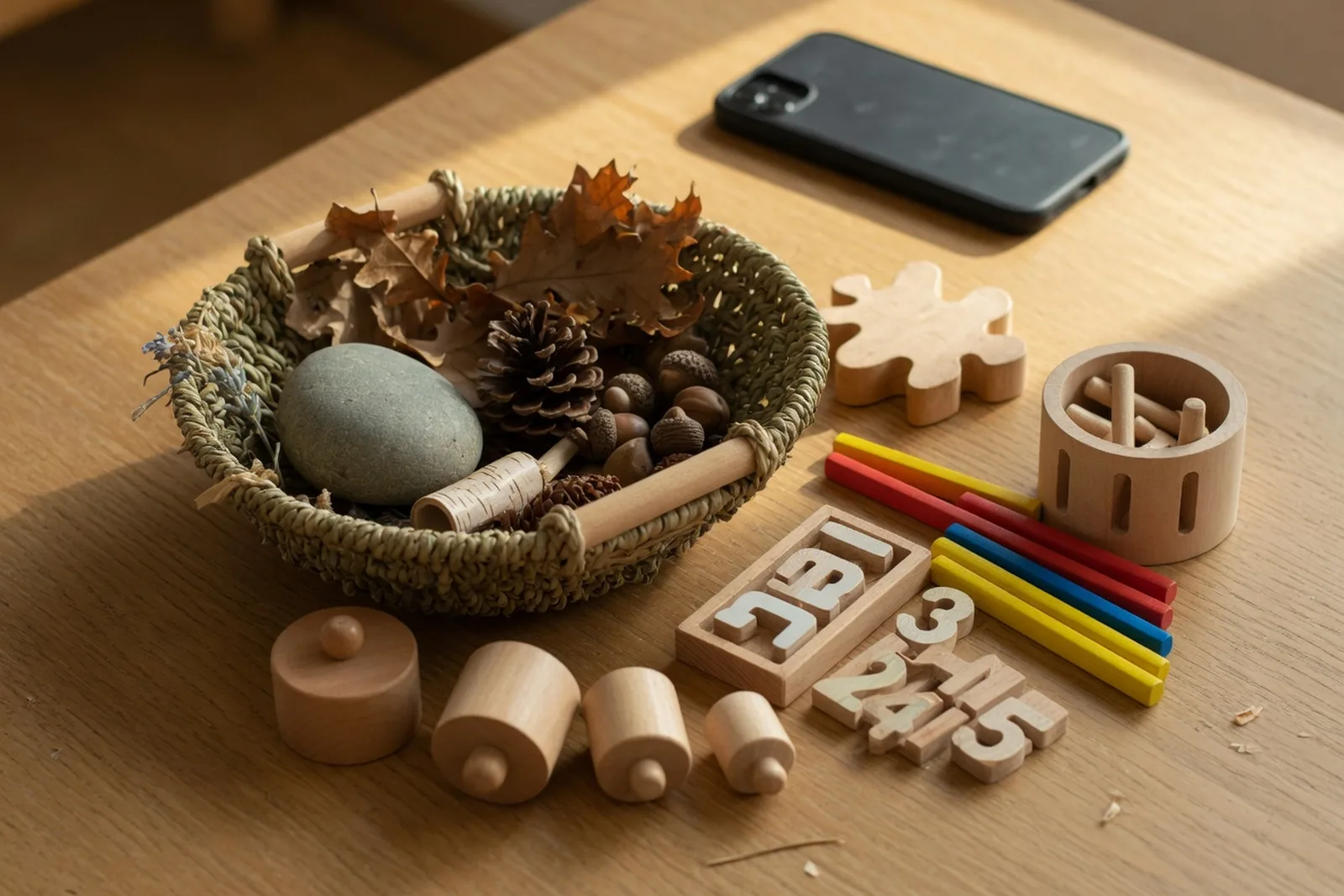
The real question is rarely, “Should my child ever watch a screen?” It is usually, “How do we get through a long afternoon, make dinner, or take a breath without turning every screen off forever?” That is a reasonable question. Screens are part of family life. The goal is not perfection. It is to make sure they do not quietly take the place of the experiences your child needs most.
A Montessori home does not require a spotless playroom, homemade materials, or a parent who is available every minute. It asks a simpler question: what can your child do with their hands, body, attention, and growing independence right now? When the answer is clear, screens become one choice among many instead of the default.
What hands-on development offers
A screen can tell a child about a bird. It cannot give them the shifting weight of seed in a scoop, the patience of filling a feeder, or the surprise of seeing a bird arrive. Young children build understanding by moving through the real world. They carry, pour, sort, climb, repeat, and notice.
That kind of work develops more than coordination. It gives children feedback they can feel. A block tower falls, so they try a wider base. Water spills, so they find a cloth. A zipper catches, so they slow down and try again. These small problems ask for attention, persistence, language, and self-control all at once.
Screens can be entertaining, informative, and sometimes genuinely useful. They are not a moral failure. But they are designed to hold attention for the child, while real activity asks the child to direct attention. Both have a place, yet they are not interchangeable. A video call with a grandparent builds connection differently than an autoplayed stream of clips, and a family movie can be a shared ritual rather than a way to fill every quiet moment.
This is part of why a Montessori classroom protects a long, uninterrupted block of work each morning instead of rotating through short stations. When a child has real materials, real time, and a guide who is watching rather than directing every minute, the pull of a screen has genuine competition. You can read more about how that block works in The Three-Hour Work Cycle, Explained. At home you will not recreate three hours before breakfast, but the principle scales down: fewer interruptions, more real choices, and enough time for your child to get absorbed in something that is not a screen.
Start with guidance, then notice your family
Current pediatric guidance generally emphasizes developmentally appropriate, intentional media use, adult involvement for young children, and enough time protected for sleep, movement, conversation, and play. It also encourages families to consider content, context, and the individual child instead of treating every minute of screen use as identical.
That framework is useful because it moves the conversation past a daily total. Ask what the screen is doing in a particular moment. Is it helping your family connect? Is an adult nearby to talk about what the child sees? Is it crowding out bedtime, outdoor time, meals, reading, or independent play? Does your child move on without a battle, or does stopping feel impossible?
You do not need to change everything at once. Pick one predictable part of the day, such as the first 30 minutes after school or the hour before bed. Protect it from passive media for a week and see what emerges. The first few days may feel noisy. Boredom is often the space before a child finds something to do.
Make the better option easy to reach
Children choose what is visible, possible, and familiar. A few well-placed materials often work better than a closet full of toys. Keep choices limited, rotate them when interest fades, and set up activities your child can begin without waiting for you.
Toddlers: offer real jobs in small portions
For toddlers, movement and participation matter. Put a small pitcher of water beside a cup, a basket of washcloths near a low surface, or a child-sized broom where they can reach it. Let them transfer socks from the laundry basket, wipe a small spill, peel a banana, or carry napkins to the table. These tasks take longer than doing them yourself, but they meet the toddler’s wish to belong.
Ages 3 to 6: build a rhythm of choice and contribution
Children in Early Childhood can care for plants, wash fruit, match socks, set the table, make a simple snack, and help pack for tomorrow. Offer open-ended materials too: paper and tape, clay, blocks, puzzles, a basket of books, and crayons. Try placing one activity on a tray, with everything needed to finish it. A clear beginning and end can make independent work feel more inviting than an open-ended request to “go play.”
Elementary children: invite ownership
Elementary-aged children can take on work that matters to the household. They might plan one dinner each week, compare prices for a grocery list, organize a shelf, repair a loose button, research a question that came up at breakfast, or manage a neighborhood errand with you. They also need unstructured time to read, build, make, and spend time with friends. The point is not to keep them busy. It is to give them room to practice judgment.
Curious what this looks like in a real classroom?
Schedule a VisitUse transitions instead of surprise endings
Many screen-time conflicts begin at the ending, not during the show. A child who is deeply absorbed, or simply used to an abrupt handoff, needs a bridge. Name the plan before the screen goes on: “One episode, then shoes for the walk,” or “You may watch while I finish these dishes. When the timer rings, you can choose music for our cleanup.”
Give a warning that your child can understand, then make the next activity concrete. “Five more minutes” is less helpful than “When this song ends, we are taking the recycling out.” A timer can keep the parent from becoming the bad guy, but it should not be the only tool. Your calm follow-through matters more.
When the screen goes off, expect feelings. You can hold the limit and acknowledge disappointment: “You wanted more. It is hard to stop. The show is finished for today.” Long explanations during a protest usually add fuel. Connection, a clear boundary, and a next step are enough.
Write a family media agreement you can actually keep
A family media agreement does not need formal language. It can be a short list on the refrigerator, written with children who are old enough to contribute. Keep it specific to your life and revise it when it stops working.
- We choose programs, games, and videos before we open an app.
- We keep meals, bedrooms, and family conversations free from personal devices.
- We protect time for sleep, outdoor movement, reading, chores, and play first.
- We use screens together when the content is new, confusing, or meant to be discussed.
- Adults follow the same phone boundaries they ask of children.
That last point carries weight. Children notice when a parent asks for device-free dinner while answering messages at the table. You do not need to model flawless attention. You can model repair: “I was checking my phone while you were talking. I am putting it away. Tell me again.”
Let the home be real, not optimized
Some days will include more media than you planned. A sick child, a delayed flight, an urgent call, or a hard week can change the plan. You have not undone your child’s development. Return to the next ordinary opportunity: invite them to stir the pancake batter, walk to the mailbox, choose a book, or help rinse the dishes.
Montessori at home is less about producing the right activity and more about making space for real life. Children gain confidence when they are trusted with manageable work, given time to concentrate, and welcomed into the rhythms of the family. Screens can fit within that life. They just should not replace it.